Why African Contact Centres Are Moving from On-Premise to Cloud Telephony

Published by Laddar Africa | Voice & Customer Engagement
Most African enterprise contact centres are running on one of two systems: a cloud phone system or a traditional office phone system purchased years ago, maintained by an internal team and invoiced in US dollars for equipment that loses value every year.
Both work. The question is what each one costs to run, grow and recover from when something goes wrong and whether the trade-offs still make sense today.
The cost difference
Traditional office phone system
You pay a large upfront sum to purchase and install the equipment. Then you pay for ongoing maintenance through your internal team or a vendor contract. When the equipment gets old, the purchase cycle starts again. All of it is priced in US dollars.
For Nigerian businesses, this is not a fixed cost. Every time the naira weakens, the real cost of maintaining that system goes up before a single upgrade is made.
Cloud phone system
No equipment to buy. No depreciation. A predictable monthly subscription that goes up or down as your team changes. For finance teams managing tight budgets, that certainty has value beyond the headline saving.
| Every time the naira weakens, the real cost of running a traditional phone system rises before a single upgrade is made. |
What happens when the system goes down
A traditional office phone system is only as reliable as the building it sits in. One power cut, one equipment fault, one flooded server room and your entire contact centre goes offline.
| What one hour of downtime actually costsAt 500 calls per hour, resolved at an average of N5,000 per call, one hour offline costs N2.5 million in lost before customer complaints, contract penalties or reputational damage.A traditional system puts that risk in one location. A cloud system automatically routes calls to backup servers in multiple secure locations. If one location has a problem, your agents keep working. |
Most enterprise cloud providers guarantee 99.9% availability, fewer than nine hours of total downtime per year, most of it during planned maintenance.
Supporting agents who are not in the office
Traditional phone systems are built for one location. If your agents need to work from home, another office or a remote site, you need additional tools and setup, more cost, more complexity.
A cloud system assumes your agents can be anywhere. Someone in Lagos, Abuja or working from home gets the same system, the same call quality and the same management visibility as an agent in the main office. Nothing extra required.
Knowing what is happening right now
Traditional phone systems were built to connect calls, not to give management information. If you want to know how many calls are waiting, how long customers have been on hold, or how your team is performing right now, that information is usually not available until the end of the day.
A cloud system gives you that visibility live, call information, wait times, agent availability and missed calls, all on a screen that managers can act on during the working day.
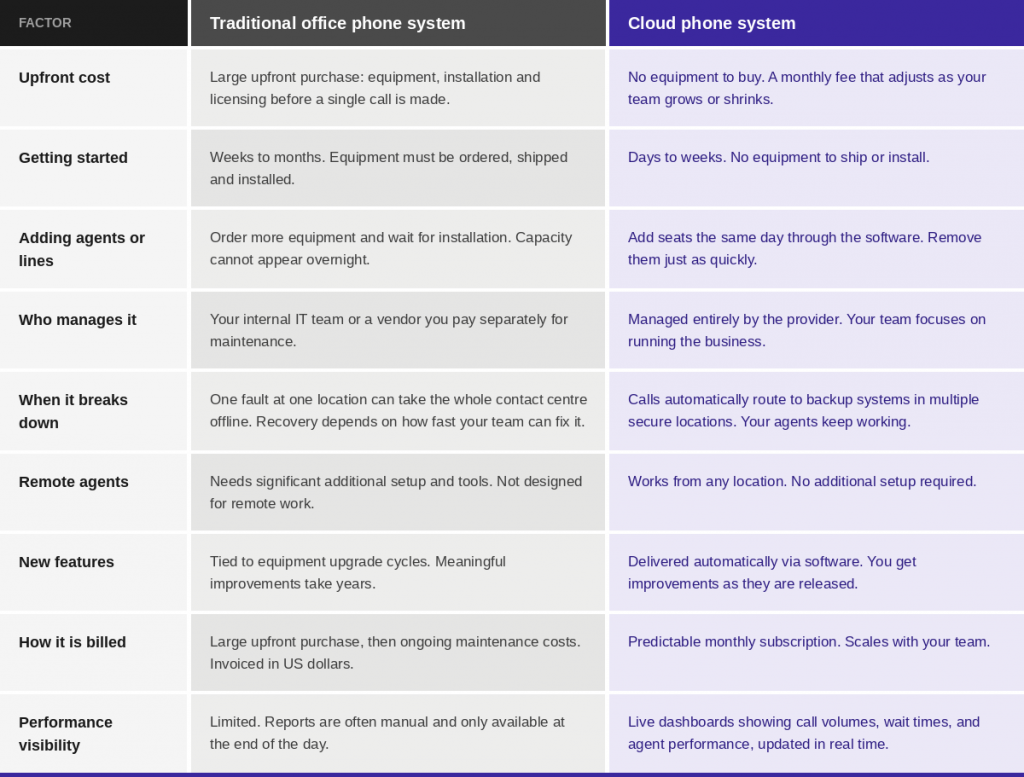
How the two systems compare
Key takeaways
- Traditional office phone systems require a large upfront purchase, carry dollar-denominated maintenance costs that rise with exchange rate movements and fail as a single point when the building has a problem.
- Cloud phone systems convert your phone infrastructure into a predictable monthly cost, scale without equipment purchases, and route calls to backup systems automatically if there is a disruption.
- Live dashboards give managers real-time visibility into what is happening in the contact centre, so decisions are made during the working day, not the following morning.
Conclusion
The gap between what a traditional phone system can do and what a cloud system offers has widened significantly. The organisations making this decision now have access to cloud platforms built specifically for the reliability, compliance, and business realities of African markets.
The question is no longer whether a cloud phone system can handle enterprise contact centre volumes. It is whether your current system is still the right cost structure for what your business needs to do.
| Laddar Voice delivers cloud-based contact centre capability for African enterprises without the equipment cost, the maintenance burden or the single-point-of-failure risk of a traditional phone system. Speak with our team. Send a email at getstarted@laddar.africa |