The Management Gap in African Field Sales
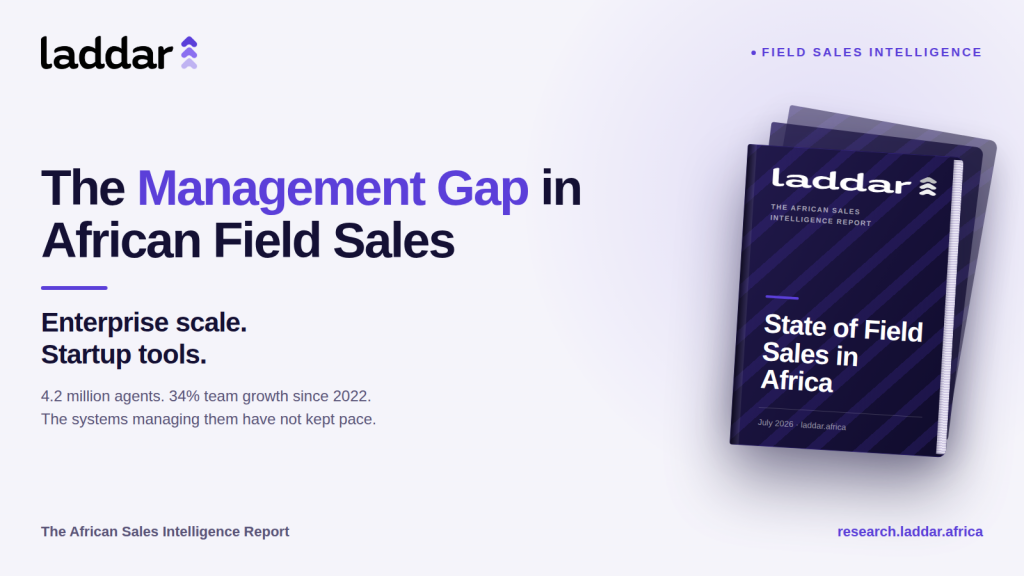
Field sales is the engine of African commerce. Across the continent, more than 4.2 million agents sell, collect payments, onboard customers and carry the brand into territories that no digital channel reaches. The average enterprise field team in Nigeria has grown by 34% since 2022, and 71% of companies intend to expand their field teams again within the year.
The teams have scaled. The systems managing them have not.
The African Sales Intelligence Report, our new study of field sales across the continent, set out to measure this precisely. It draws on Laddar platform data, structured interviews with sales leadership, and third-party research from McKinsey, Briter Bridges, the GSMA and the IFC. What it found is a gap between how large these operations have become and how they are actually run.
Enterprise scale, startup tools
More than half of enterprise field teams, 54%, still manage their agents through WhatsApp groups. Another 29% rely on spreadsheets and phone calls. Only 4% of companies with field teams above 50 agents use dedicated field management software.
WhatsApp is not a management system. It has no auditability, no location verification, no call recording, and no connection to any sales pipeline. When an agent leaves, the company loses every customer relationship that agent held in their personal phone. For an operation moving millions in revenue through hundreds of agents, that is not a small gap. It is a structural risk.
Why imported tools do not close it
The instinct is to reach for a global CRM. The problem is that most were built for a different reality: stable internet, dollar billing, laptop-first workflows and inside sales motions. African field agents work in low-bandwidth zones, on Android phones, across dozens of territories at once, with the call as their primary sales channel. A tool that assumes the opposite does not fit, which is why 48% of large enterprises that tried building or adapting their own eventually abandoned the effort, at a median cost of N47 million.
The point of the report is not that African field sales lacks data. It is that field sales here has its own physics, and it needs to be measured on its own terms. That is what this study does.
Read the full report, covering six markets, the accountability data and the 2026 pressures reshaping the market: research.laddar.africa