
Why African Field Agents Really Quit
Ask most sales leaders why their field agents leave and you will hear the same answers: pay, competition, the hard nature of the work. Ask them about accountability tools and many will tell you those make retention worse. Agents resist being tracked, the argument goes, so monitoring drives them out.
The data in the African Sales Intelligence Report says the opposite, and the size of the effect is hard to ignore.
The number that changes the conversation
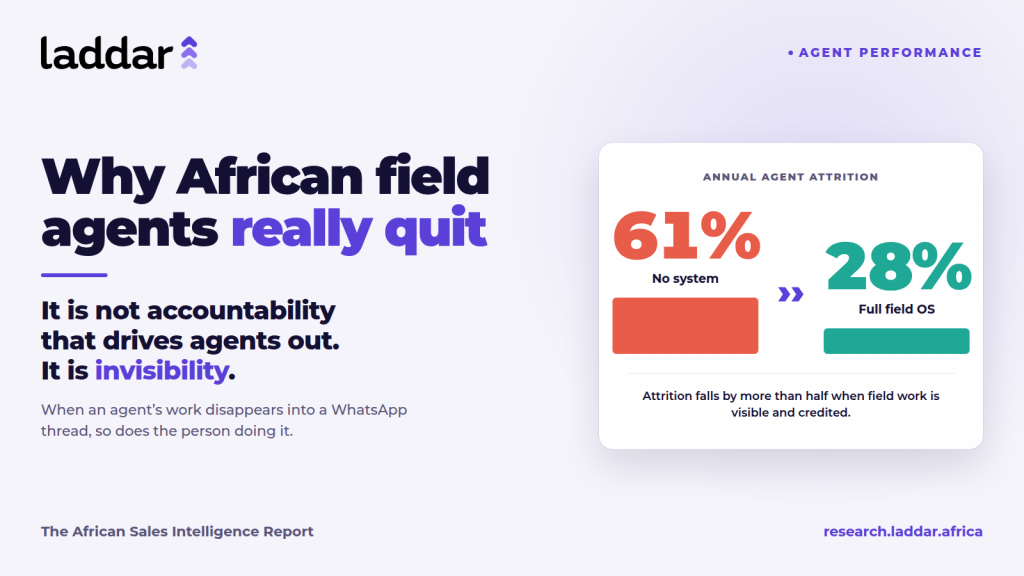
On field teams with no accountability system, annual agent attrition runs at 61%. On teams with a full field operating system, it falls to 28%. Less than half.
This is not a small optimisation. In Nigeria and Kenya, average field agent turnover sits at 44% a year, and in some telecoms and FMCG territories it passes 60%. Every departing agent takes route knowledge, customer relationships and contact data that was never formally recorded. Replacing one agent costs between half and twice their annual salary. For a 100-agent team, that is a recurring annual cost of N18 million to N72 million.
Invisibility, not accountability
The report is direct about the cause. It is not accountability that drives agents out. It is invisibility.
An agent whose daily visits are recorded, credited and coached is an agent who can be recognised and promoted on evidence. An agent whose work disappears into a WhatsApp thread at the end of each day has no record to stand on. When the work is invisible, so is the person doing it, and invisible people leave.
This reframes attrition entirely. It is not an HR cost to be managed after the fact. It is a revenue event that better systems prevent. The teams in the study with the lowest turnover were not paying the most. They were the ones that made field work visible.
The report breaks down agent performance across every accountability level and market. Read it here: research.laddar.africa/