
The Real Cost of Sales Agent Churn and How to Shorten Ramp Time
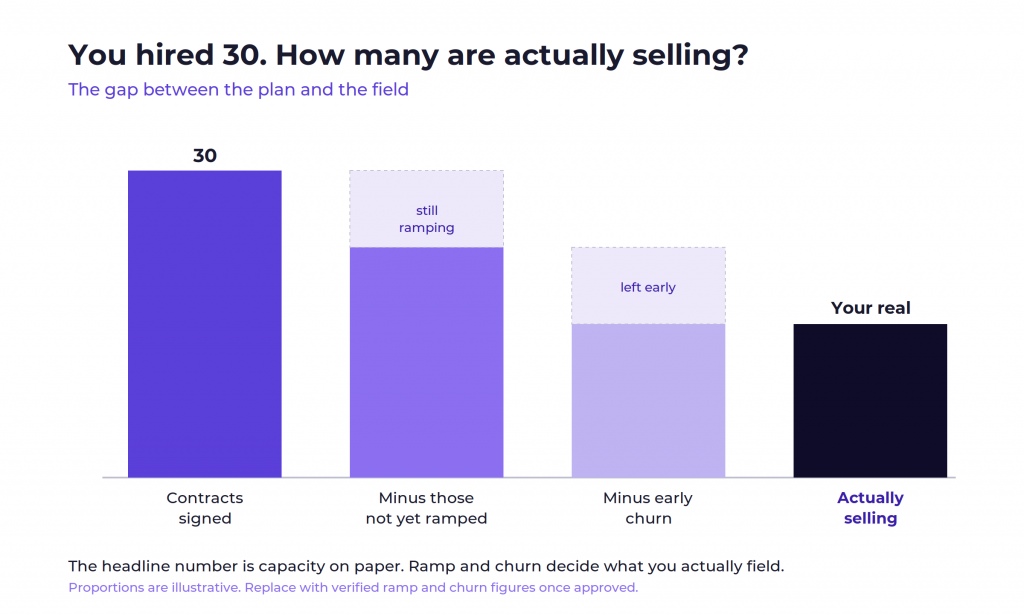
You approved 30 new agents. The plan added 30 quotas. So why does the revenue lift feel so much smaller than the headcount promised?
Because the number on a hiring plan and the number of people actually selling this month are rarely the same. Two forces sit between them: ramp time and churn. Both are quiet, both are expensive, and neither is fixed by hiring more.
A new agent is not productive on day one
A field agent has to learn the product, the territory, the pitch, the paperwork and the informal rules of the patch before they sell anything worth counting. In field sales, that ramp is measured in weeks or months, not days.
During that ramp, you are paying a full cost for a partial output. That is normal and unavoidable. What is not unavoidable is how long the ramp lasts, and how many people you lose before it ends.
Churn eats the investment before it pays back
Now add turnover. In high-volume field sales, across markets like Nigeria, agent churn is a fact of life, not an exception.
Here is the painful part. Churn is most expensive when it happens during or just after ramp. You have paid the recruitment cost, paid the onboarding cost and absorbed the low-output ramp period. Then the agent leaves, before they ever reached the productive stretch that was supposed to repay all of it.
If a meaningful share of new hires leave before they finish ramping, your effective new capacity is a fraction of the headline number. You did not field 30 agents. You fielded fewer, for less time, at full cost.
Hiring 100 salespeople does not give you a 100-person sales force. It gives you 100 contracts and a ramp curve.
The three costs no one puts in the plan
When a new agent churns during ramp, you lose more than a salary.
You lose the recruitment spend that found them. You lose the onboarding time your managers and best agents put in. And you lose the momentum in their territory, because a half-worked patch has to be picked up cold by someone else, or left to go quiet.
Multiply that across a hiring wave and the headline “we added 30 agents” hides a much smaller, much more expensive reality.
How to shorten ramp time
Ramp is not a fixed law. Most of what makes it long is friction you can remove.
Make onboarding repeatable, not personal. If ramp depends on a specific manager finding time to train each new agent by hand, it will always be slow and uneven. A structured, consistent onboarding path means every new agent gets the same fast start, regardless of who is free that week.
Give new agents visibility into their own performance from day one. When an agent can see how they are tracking, in real time, they self-correct faster than they would waiting for a weekly review.
Put the tools in their hands, not in a back office. When capturing a sale, logging a visit and getting paid are simple and immediate, new agents reach confident, independent working faster.
How to reduce churn
Churn during ramp often comes down to two things: agents who never became productive, and agents who did the work but felt the system did not pay them fairly.
The first is a ramp problem, addressed above. The second is an incentive problem. When commission is calculated by hand, delayed and disputed, your newest agents, the ones with the least loyalty banked, are the quickest to walk. Transparent, automatic incentive calculation removes a major, avoidable reason to leave.
This is where the talent layer and the operating layer meet. Laddar People helps businesses access and deploy sales agents; Laddar Field OS gives those agents the visibility, onboarding structure and clean incentives that turn a new hire into a productive one, and keep them long enough to pay back the investment.
The honest way to plan a hire
Before your next hiring wave, do the subtraction the plan usually skips. Take the headline number. Reduce it for the ramp period, when output is partial. Reduce it again for the share you expect to lose before they finish ramping.
The number left is your real new capacity. It is smaller than the plan says, and knowing that changes how much you should rely on hiring to hit next year’s target.
FAQ
How long does it take a new field sales agent to become productive? Longer than most plans assume. Field agents need time to learn the product, territory and process, and productivity builds over weeks or months rather than days. A meaningful share also leave before they finish ramping, which means the number you hired and the number producing revenue are rarely the same.
How can I reduce sales agent churn? Address the two biggest causes: agents who never became productive, and agents who felt unfairly paid. A repeatable onboarding path shortens ramp and lifts early productivity, while transparent, automatic commission removes a common reason new agents leave.