
Scaling Into New Territories Without Losing Control
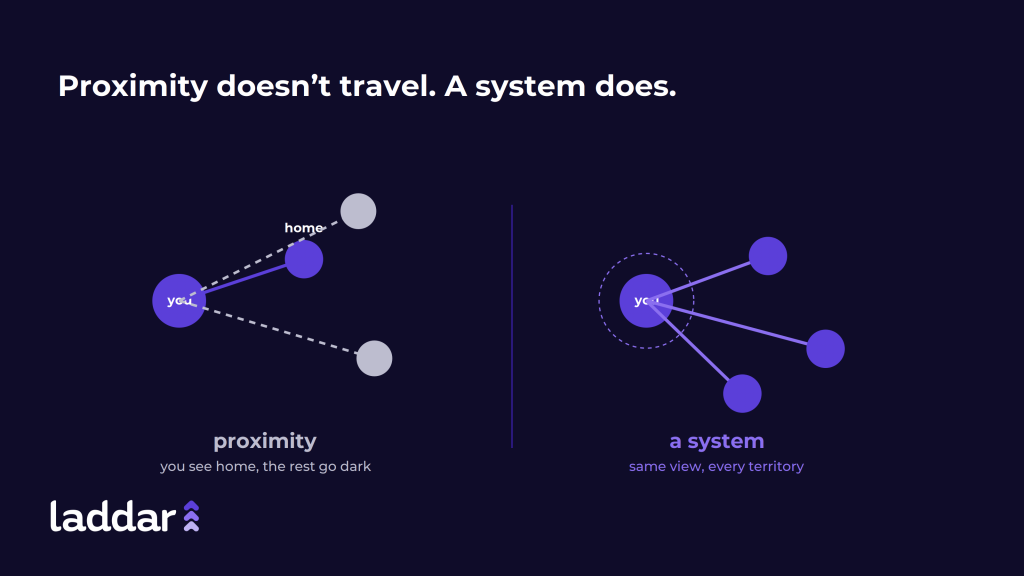
Expansion is the moment a sales operation is most exposed. A business that runs beautifully in one city decides to enter a second, then a third, and discovers that the control it took for granted at home does not travel with it. The market opportunity is real. The operational grip is what breaks.
Understanding why control fails at distance is the key to expanding without flying blind, and it is rarely about the new market being harder to sell in. It is about the old way of managing not stretching that far.
Why control breaks at distance
In the home territory, a lot of management is informal and invisible. You are close to the team. You can drop by, sense the mood, hear things in passing, trust people you know personally. That proximity does an enormous amount of quiet management work that no one has ever written down.
The moment you expand, all of that disappears. The new territory is too far to drop by, the people are unfamiliar, and the informal signals that kept the home operation honest simply do not reach. What is left is whatever your systems can actually see, and if the answer at home was “not much, because I was there,” expansion reveals that you never really had a system, you had proximity.
The failure modes of expansion
When proximity vanishes and no system replaces it, expansion goes wrong in predictable ways.
The new territory becomes a black box. You get reports, but you cannot verify them, cannot feel the ground truth, and cannot tell a real problem from a reporting one until it is large.
Standards drift. The way things are done at home does not transfer, because it lived in habit and supervision rather than in a repeatable process, so each new territory reinvents its own version.
Problems surface late. Issues that you would have caught in a corridor at home now reach you weeks later through a report, by which point they are expensive.
Trust replaces verification, at exactly the wrong moment. You extend trust to people you do not yet know, in places you cannot see, which is precisely where trust is least warranted.
Expansion does not create these weaknesses. It exposes ones that proximity was hiding.
Control has to move from proximity to system
The businesses that expand well make one shift before they scale: they move their control from proximity to system. Instead of relying on being close, they build the visibility and process that work the same at any distance.
That means being able to see, in real time, what is happening in any territory without being there. It means a repeatable way of operating that a new territory inherits rather than reinvents. It means activity you can verify remotely, so trust is backed by evidence. And it means problems surfacing while they are small, wherever they occur.
With those in place, the second city is not a leap of faith. It is the first city’s system, applied somewhere new. Distance stops being the enemy of control.
Build the system before you need it
The mistake most operations make is expanding first and trying to build control afterwards, in the middle of the chaos. The better sequence is to build the system while you are still close enough to see whether it works, then expand behind it.
This is what Laddar Field OS is designed to give an expanding operation: real-time visibility, verified activity and a repeatable way of running that hold up across cities and regions, so control does not depend on being in the room. Before you enter the next territory, the question worth answering is not “is the market there.” It is “will my control travel.” If your grip on the home operation lives in proximity rather than in a system, expansion will find that out for you. Better to find it out first.
FAQ
Why do sales operations lose control when they expand? Because in the home territory much of the management is informal, based on proximity: dropping by, sensing the mood, trusting familiar people. That does not travel. When you expand, only what your systems can see remains, and if that was little, expansion reveals you had proximity, not a system.
How do you scale into new territories without losing visibility? Move control from proximity to system before you scale: real-time visibility that works at any distance, a repeatable way of operating each new territory inherits, remotely verifiable activity, and problems that surface while small. Then a new territory is the home system applied elsewhere.
When should you build the systems for expansion? Before you expand, while you are still close enough to see whether they work, then grow behind them, rather than trying to build control in the middle of the chaos after you have already stretched too far.