The Trust Tax: The Hidden Surcharge on Everything You Sell
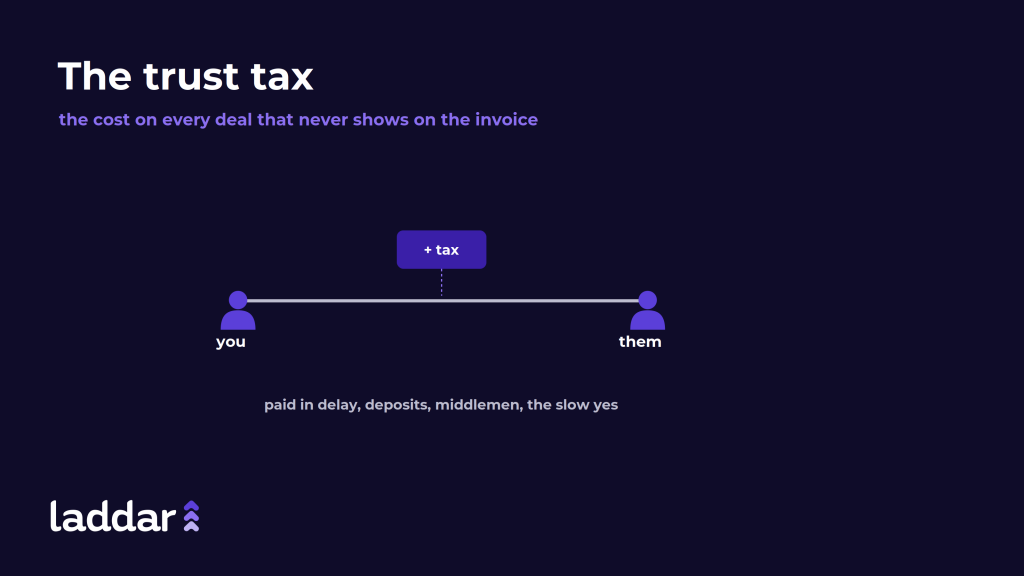
There is a cost buried in almost every transaction in African business that never appears on an invoice. Call it the trust tax: the extra time, money and effort you spend because parties cannot simply take each other at their word.
It is the deposit demanded before work begins. The middleman who exists only to vouch. The cash insisted on because a promise to pay is not enough. The double-checking, the guarantees, the slow yes. None of it adds value. All of it is the price of operating where trust cannot be assumed.
Understanding the trust tax, and how to lower it, is one of the most useful lenses a growth leader can adopt, because it sits underneath problems that look unrelated.
Where you pay the trust tax
Look at a field sales operation and you can see the tax being paid at three points.
Between the company and its agents. Because you cannot fully verify what agents do in the field, you compensate with layers of supervision, reconciliation and caution. That overhead is trust tax.
Between the company and its customers. Because customers cannot be sure you will deliver, they hesitate, negotiate harder, or insist on terms that protect them. The friction in closing is trust tax.
Between agents and customers. Because a customer does not yet trust an agent, the sale takes longer, needs a referral, or happens only through someone already trusted. The extra steps are trust tax.
Add these up across thousands of interactions and the tax becomes one of the largest, least visible costs in the business.
Why the tax is high here, and why that is rational
It is tempting to treat low trust as a cultural failing. It is not. It is a rational response to an environment where formal enforcement is weak, information is scarce, and being wrong is expensive. When you cannot easily verify a claim or recover from a broken promise, caution is intelligent.
So people build their own trust infrastructure by hand: personal relationships, reputation networks, cash, intermediaries. These work, which is exactly why they persist. The problem is that hand-built trust does not scale. It is slow, it is local, and it lives in individuals rather than the business.
The expensive ways businesses cope
Most operations pay the trust tax rather than reduce it, usually in one of three ways.
They rely on personal relationships, which means growth is capped by how many people the founder or a key manager personally knows and vouches for.
They insist on cash and upfront terms, which protects them but shrinks the market to those who can and will pay that way.
They add intermediaries and checks, which buys confidence at the cost of speed and margin.
Each of these keeps the business safe and small. The tax is paid, and growth is the currency.
The alternative: make trust unnecessary
The most powerful move is not to demand more trust. It is to make trust less necessary, by making things verifiable.
You do not need to trust an agent’s word about a visit if the visit is verified. You do not need a middleman to vouch for activity if the activity is recorded and checkable. You do not need to rely on memory and relationships if the history is captured and belongs to the business. When something can be verified, it no longer has to be trusted, and the tax on that interaction falls toward zero.
This is the quiet reason systems matter so much in low-trust markets. Their deepest value is not efficiency; it is that they replace fragile, hand-built, personal trust with something scalable and shared. A verified operation can move faster, reach further and leak less, because it is no longer paying the trust tax by hand.
Lowering the tax compounds
A lower trust tax does not just save a cost. It changes what is possible. Deals that were too slow become viable. Markets that were too risky become reachable. Agents you could not verify become manageable. Every point of trust you can systematise is a point of growth you can unlock.
This is a large part of what Laddar Africa is built to do: make field activity, sales and customer relationships verifiable and owned by the business, so trust stops being something you buy expensively by hand. But the idea stands on its own. Before you accept a limit on how far or how fast you can grow, it is worth asking how much of that limit is really a trust tax, and how much of it you could stop paying.
FAQ
What is the trust tax in business? It is the hidden cost of operating where parties cannot take each other at their word: the deposits, middlemen, cash insistence, extra checks and slow decisions that add no value but are the price of low trust. It shows up across company-agent, company-customer and agent-customer relationships.
Why is trust lower in some markets? Usually because formal enforcement is weak, information is scarce and mistakes are costly, which makes caution rational rather than cultural. People respond by building trust through personal relationships, cash and intermediaries, which work but do not scale.
How do you reduce the trust tax? By making things verifiable rather than demanding more trust. When activity, sales and history can be checked, they no longer have to be trusted, so the friction on each interaction falls and growth that was blocked by caution becomes possible.