
Why More Salespeople Don’t Always Mean More Sales
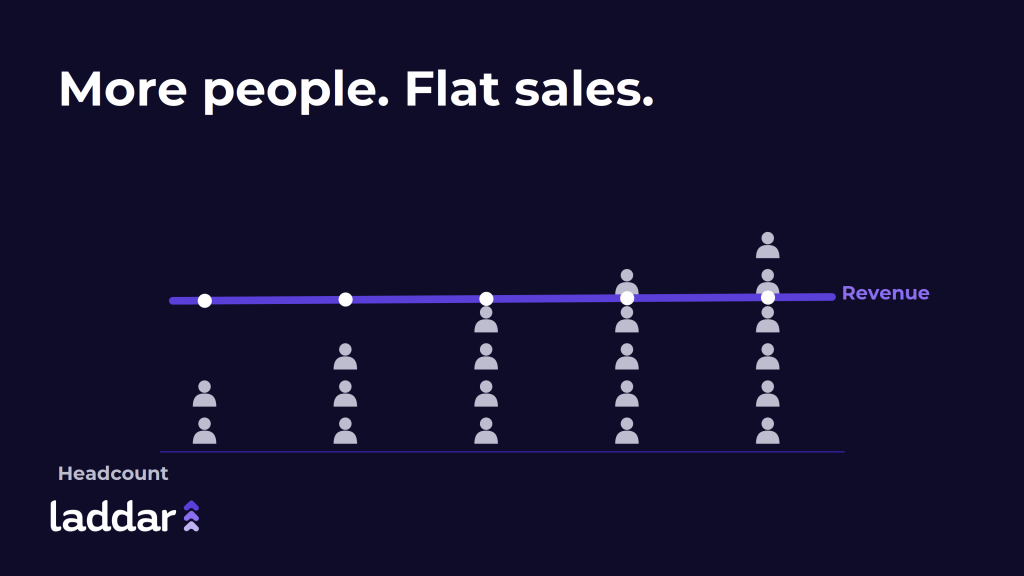
Sales are flat. The board wants a plan. The fastest answer, the one that feels obvious, is to hire more salespeople.
It is a reasonable instinct. If five agents produce a certain amount of revenue, 20 should produce four times as much. On a spreadsheet, the maths is clean.
On the ground, it rarely works that way.
Plenty of African businesses have doubled their sales headcount and watched revenue move only slightly, while costs rose in a straight line. The new agents did not fail because they were poor hires. They failed because they were added to a system that could not absorb them.
This article explains why more salespeople do not automatically mean more sales, how to tell whether you actually have a headcount problem, and what to fix first if you do not.
The maths that looks right on paper
The assumption behind most hiring decisions is that sales output scales in a straight line with the number of people selling. Add a rep, add their quota. Add ten reps, add ten quotas.
Real sales operations do not behave like that, for one simple reason: revenue per rep is not a fixed number. It depends on how well each person is recruited, onboarded, managed, supported and held accountable. Every one of those things gets harder as the team grows.
So the honest version of the maths is this. Each new hire adds capacity, but they also add load: more people to train, more activity to track, more territory to cover, more commission to calculate, more conversations to monitor. When the load grows faster than your ability to manage it, output per rep falls. Past a certain point, adding people can lower the average even as the total creeps up.
That is the moment leaders misread. Revenue is technically higher, so hiring looks justified, but cost per sale has quietly risen and the team is harder to run than before.
Where the extra headcount actually goes
When new salespeople do not produce, the reason is usually one of four things. None of them is solved by hiring more people.
Management attention is a fixed resource
A sales manager can only pay real attention to so many people. They can coach a handful closely. They can keep loose track of a dozen. Beyond that, “management” becomes a weekly report and a group chat.
When you add agents without adding management capacity, or the systems that extend it, each person gets a thinner slice of attention. The strongest performers coast on their own discipline. Everyone else drifts, because nobody is close enough to notice in time.
This is why a team of 40 agents under one overstretched manager often sells less per head than a team of 15 under a manager who can actually see what each person is doing.
Ramp time and churn eat the first months
A new agent is not productive on day one. They need to learn the product, the territory, the pitch and the paperwork. In field roles, ramp is measured in weeks or months, not days.
Now add churn. In high-volume field sales across markets like Nigeria, agent turnover is a fact of life. If a meaningful share of new hires leave before they finish ramping, you are paying for onboarding you never recover. You hired 30 people; you effectively fielded far fewer, for far less time than the headline number suggests.
Hiring 100 salespeople does not give you a 100-person sales force. It gives you 100 contracts and a ramp curve.
A broken process multiplies, it does not improve
If your current five agents are working from personal WhatsApp numbers, logging visits on paper, and sending sales in at the end of the day, adding 20 more does not fix any of that. It scales it.
You now have 25 people running an unreliable process instead of five. More missed follow-ups. More lost customer context when someone leaves. More disputes over what was actually sold and to whom. The dysfunction that was tolerable at small scale becomes the main constraint at large scale.
A weak process is the one thing that reliably gets worse when you pour more people into it.
Without visibility, more agents means more blind spots
Here is the quiet cost. When you cannot see what your agents do each day, every new hire is another person you are managing on trust and end-of-day summaries.
Are they where they say they are? Are the visits real? Is the activity genuine, or is a spreadsheet being filled in from a bench? At five agents you can more or less feel the answer. At 50, spread across Lagos, Abuja and Port Harcourt, you cannot. The gap between what is reported and what is happening widens with every hire, and sales leakage hides in that gap.
More salespeople, in other words, can mean more revenue you cannot verify.
The real question: headcount or execution?
Before you sign off on a hiring plan, it is worth asking whether the constraint is genuinely the number of people. A few honest questions usually settle it.
- Do your current top performers have more demand than they can service? If your best people are turning away qualified opportunities, that is a real capacity signal.
- Do you know, without asking a manager, how many productive selling hours happened yesterday? If you do not, the problem is visibility, not headcount.
- Is the spread between your best and worst agents large? A wide gap means the issue is how you manage and coach, not how many you employ. Hiring will just add more people to the bottom of that range.
- Are leads and follow-ups falling through the cracks? If existing demand is leaking, more agents will leak more.
- Can you calculate commissions and verify activity quickly and cleanly? If this is manual and disputed, scaling the team scales the arguments.
If the answer to most of these points to control rather than capacity, you have an execution problem wearing a headcount costume. Hiring will make it more expensive, not less.
What to fix before you hire
The businesses that scale sales successfully tend to do the unglamorous work first. They make each rep more productive before they add the next one.
That usually means getting a few things in place: real-time visibility of what agents actually do in the field, a single reliable record of every sale and customer instead of scattered notebooks and personal phones, a repeatable onboarding path so new agents ramp faster, and automated, transparent commission calculation so incentives motivate rather than provoke.
Fix those, and something useful happens. Your existing team sells more, because the friction is gone. And when you do hire, the new people step into a system that makes them productive quickly, instead of into a fog that hides their performance until it is too late to correct.
The goal is not a bigger sales force. It is a sales force where each additional person genuinely adds sales.
The system beats the headcount
This is the shift behind Laddar Field OS, the field operations platform from Laddar Africa. The premise is that most sales teams are not short of people. They are short of visibility, structure and accountability, which is what makes the people they already have hard to manage and slow to scale.
Laddar Field OS connects the parts of the operation that usually live in separate places: campaigns, agents, field activity, sales, incentives and performance data, in one system. Managers can see who is active and where, verify that field activity is real, capture sales and customer data reliably rather than through personal phones, and calculate incentives without a monthly argument.
The proof that this is a systems problem rather than a headcount one shows up at scale. The point stands whether or not you ever use the platform: before you add salespeople, make sure you can actually see and manage the ones you have.
Read next
If you lead a distributed or field sales team, the African Sales Intelligence Report goes deeper into how sales teams across the continent actually perform, and where revenue leaks before it reaches the books.
Explore the African Sales Intelligence Report to see what the data says about sales productivity in African markets.
FAQ
Does hiring more salespeople increase sales? Not on its own. Adding salespeople increases capacity, but sales only rise if each new person can be onboarded, managed and held accountable. When the team grows faster than your ability to manage it, output per rep falls and cost per sale rises. Hiring helps when your best people genuinely cannot service existing demand. It rarely helps when the real constraint is visibility, process or accountability.
How do I know if I have a sales headcount problem or a management problem? Look at whether your existing demand is being fully served. If leads and follow-ups are leaking, if the gap between your best and worst agents is wide, or if you cannot see what your team does each day without asking a manager, the constraint is management and visibility, not headcount. Adding people to that situation multiplies the problem rather than solving it.
What is a realistic span of control for a sales manager? It depends heavily on how distributed the team is and how much of the management is supported by systems. A manager coaching closely and manually can hold real attention for only a small number of agents. Tools that give real-time visibility and automate reporting extend that reach considerably, which is often a cheaper way to gain capacity than hiring another layer of managers.
How long does it take a new field sales agent to become productive? Longer than most plans assume. Field agents need time to learn the product, the territory and the process, and a share of new hires typically leave before they finish ramping. This is why a headline hiring number overstates real capacity: you are fielding fewer effective agents, for less time, than the contract count implies.
What should I fix before expanding my sales team? Four things tend to matter most: real-time visibility of field activity, a single reliable record of sales and customers, a repeatable onboarding path that shortens ramp time, and transparent, automated commission calculation. Fixing these usually lifts the output of your current team and ensures new hires become productive quickly instead of disappearing into a blind spot.