From Commission Disputes to Automated Incentives: Fixing Sales Pay at Scale
Commission is meant to be the engine of a sales team, the thing that turns effort into money and money into motivation. In a lot of businesses it does the opposite. It becomes a monthly source of error, argument and mistrust that quietly drains the team it was supposed to drive.
The cause is almost always the same: commission is calculated by hand. Here is why that breaks at scale, and what fixing it does for both retention and performance.
What manual commission actually costs
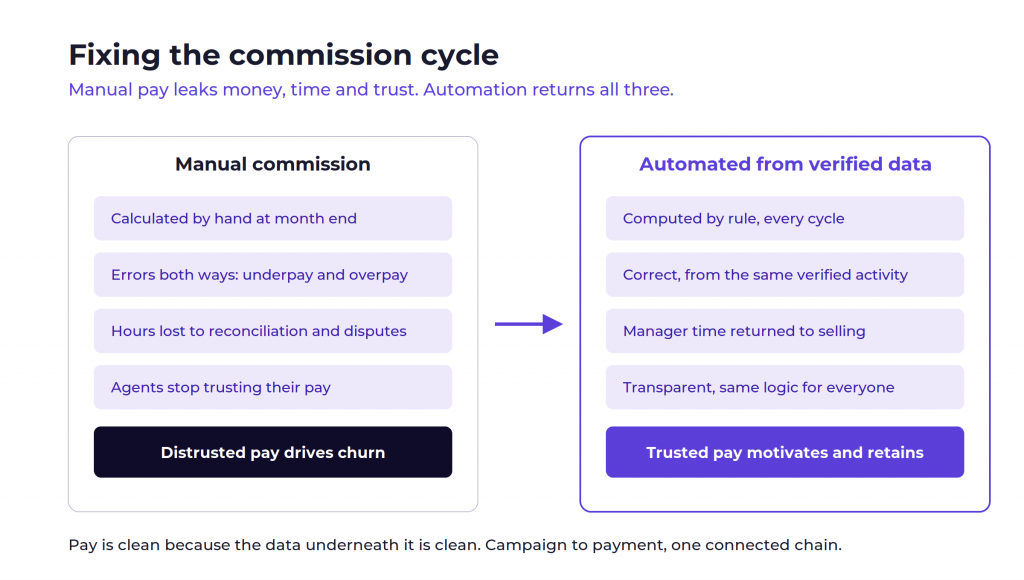
When incentives are worked out manually, usually in a spreadsheet at month end, you pay in three ways.
You pay in money. Manual calculation makes errors in both directions. Some underpay agents and breed resentment. Some overpay, through double-counting or unverified claims, and quietly cost the business. Either way, the number is not reliable.
You pay in time. Every payout cycle consumes management hours in reconciliation, and then more hours in handling the disputes that follow. That is senior time spent on arithmetic instead of on selling.
You pay in trust. This is the expensive one. When agents cannot see how their pay was calculated, and when the number is sometimes wrong, they stop trusting it. And an agent who does not trust how they are paid is an agent halfway out the door.
Pay and churn are the same problem
The link between commission and retention is direct, and it matters most for your newest agents.
A new hire has no loyalty banked. They have joined, worked hard through a ramp period, and their first real read on whether this business is worth staying for is their first few payouts. If those are late, unclear or disputed, they leave, taking the recruitment and onboarding investment with them.
So messy commission does not just cost money and time. It feeds the churn that makes hiring so unproductive in the first place. Fix the pay, and you remove one of the most common, and most avoidable, reasons agents walk.
What automating incentives changes
Automated incentives calculate pay directly from verified activity and sales data, by rule, every cycle. That single change fixes all three costs at once.
The money is correct, because it is computed from the same verified data the rest of the system runs on, not re-keyed by hand.
The time is returned, because the calculation runs itself. Managers stop reconciling and stop refereeing disputes.
The trust is restored, because the calculation is transparent and consistent. An agent can see how their number was reached, and it is the same logic for everyone, every time. Consistent, visible pay is fair pay, and agents can feel the difference.
Why this belongs in the operating system, not a separate tool
Incentives calculated in isolation are only as good as the data fed into them, and hand-fed data brings back every problem above. The reason automated incentives work is that they draw from verified field activity: confirmed visits, captured sales, real performance.
That is why this sits inside a sales operating system rather than in a standalone payroll step. Laddar Field OS calculates incentives and commission from the same verified activity it already tracks, so pay is clean because the data underneath it is clean. Campaign, agent, activity, sale, incentive and payment are one connected chain, not separate systems arguing with each other at month end.
The quiet performance gain
There is a performance dividend too, easy to miss. When agents trust that good work is paid promptly and correctly, the incentive does what it was designed to do: it motivates. When they do not, the incentive is noise, and effort drifts to whatever the agent thinks the system will actually reward or notice.
Clean, automatic, visible pay turns commission back into the engine it was meant to be. That is a productivity gain that costs you no new hires at all.
FAQ
How does automating sales commission reduce churn? Late, unclear or disputed pay is a leading reason agents, especially new ones, leave. Automating commission from verified data makes pay correct, prompt and transparent, which removes a major, avoidable reason to walk and protects your recruitment and onboarding investment.
Why calculate incentives inside a sales operating system rather than separately? Automated pay is only as reliable as the data behind it. A sales operating system calculates commission from the same verified field activity and sales it already tracks, so the pay is clean because the underlying data is clean, rather than re-keyed by hand.