Turning Sales Data Into Decisions
Plenty of sales teams have more data than they have ever had, and make worse use of it than they would like to admit. The dashboards are built, the numbers refresh, and week to week very little actually changes as a result.
This is the quiet failure of the data-driven era: businesses that are data-rich and action-poor. The fix is not more data or prettier dashboards. It is treating data as a loop rather than an output.
Collecting data is not the same as using it
Most data efforts stop at the point of display. The activity is captured, the report is generated, someone glances at it, and it is filed. The organisation feels data-driven because the data exists.
But data that does not change a decision has done no work. A dashboard nobody acts on is not intelligence. It is decoration that happens to update. The question that matters is not “do we have the data,” it is “did the data change what anyone does next week.”
Why dashboards fail to change behaviour
Three things usually break the link between data and action.
The data arrives too late. If the report describes last week, the decisions it could have informed have already been made, so it becomes a record rather than a tool.
No one owns the response. A number can flag a problem, but if it is not clear who acts on it or how, the flag is noticed and ignored.
The data is not trusted. If the figures come from manual entry and reconciliation across tools, people quietly doubt them, and you do not act on numbers you do not believe.
In each case the data is fine. The connection from data to decision to action is what is missing.
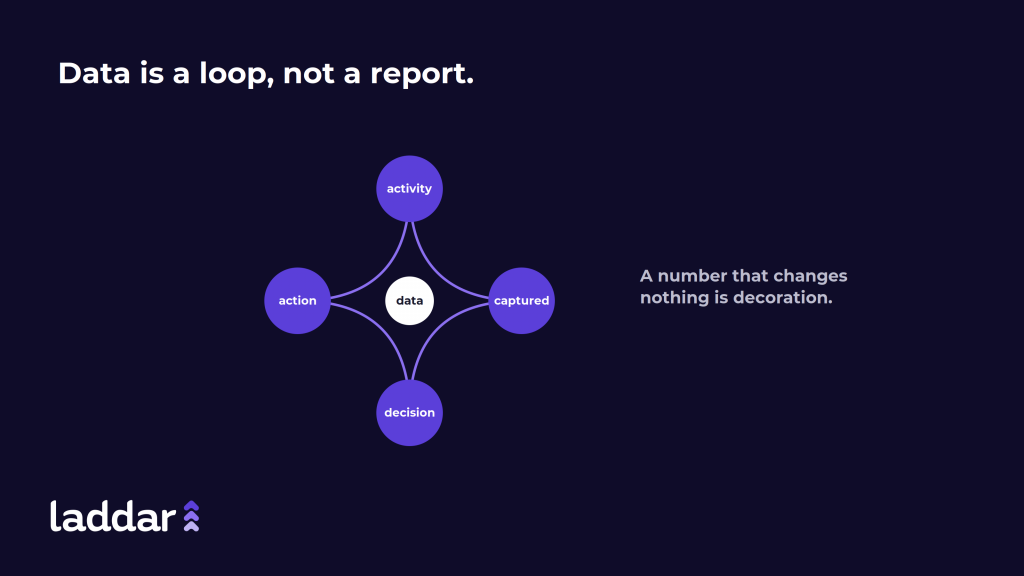
Data as a loop, not an output
The more useful way to think about data is as the connective tissue between your people and your technology, running in a loop.
People do the work. Technology captures it as it happens. That becomes data. The data informs a decision. The decision changes what people do next. And the cycle repeats, a little sharper each time.
Seen this way, data is not the last step of your operation. It is the mechanism by which people and technology improve each other. A number that does not feed back into what someone does is not part of the loop, and therefore not doing its job.
How to make sales data actually drive decisions
Closing the loop is practical, not mystical.
Capture at the point of work, so the data is current and complete rather than written up later.
Keep one source of truth, so no one wastes the meeting arguing about which figures are real.
Make it real-time, so a stalling territory or a drifting agent is visible while there is still time to act.
Tie each key number to an owner and an action, so the data points to a decision, not just a fact.
Do those, and the dashboard stops being something you look at and becomes something you run the business with.
Where the loop closes
None of this works if the data is disconnected from the people and the technology that produce and use it. That is why the loop lives inside the operation rather than in a separate reporting tool.
Laddar Field OS captures field activity and sales as they happen, keeps them in one live source of truth, and surfaces them in real time, so the data flows from what people do straight into what managers decide. The point is not more reporting. It is data that changes the next decision.
Before you commission another dashboard, ask what decision it will change and who will make it. If there is no clear answer, you do not need more data. You need to close the loop.
FAQ
Why isn’t my sales data useful even though I have a lot of it? Usually because it is disconnected from action. If the data arrives late, has no clear owner to act on it, or is not trusted, it stays a report rather than a decision. The problem is the link from data to action, not the amount of data.
What does it mean to treat data as a loop? It means data flows from what people do, through technology that captures it, into a decision that changes what people do next, then repeats. Data becomes the mechanism that lets people and technology improve each other, rather than a report at the end of the process.
How do I make sales data drive decisions? Capture it at the point of work, keep one trusted source of truth, make it real-time, and tie each key number to an owner and an action. Then the data points to a decision rather than just describing the past.