Sales Is a System, Not Just a Talent Problem
Most sales leaders become leaders because they are good at selling. They know how to build relationships, understand customers and close deals.
So when a sales team struggles, the instinct is often to look at the people. Do we need better salespeople? More training? More leads?
But as a team grows, the problem is often the system around the people.
Think about a busy restaurant. You can have great chefs and excellent waiters, but if orders keep piling up because one part of the process is slowing everything down, hiring another great chef will not necessarily fix it.
Sales works the same way.
What becomes visible when you look at the system
A sales process has its own points of pressure.
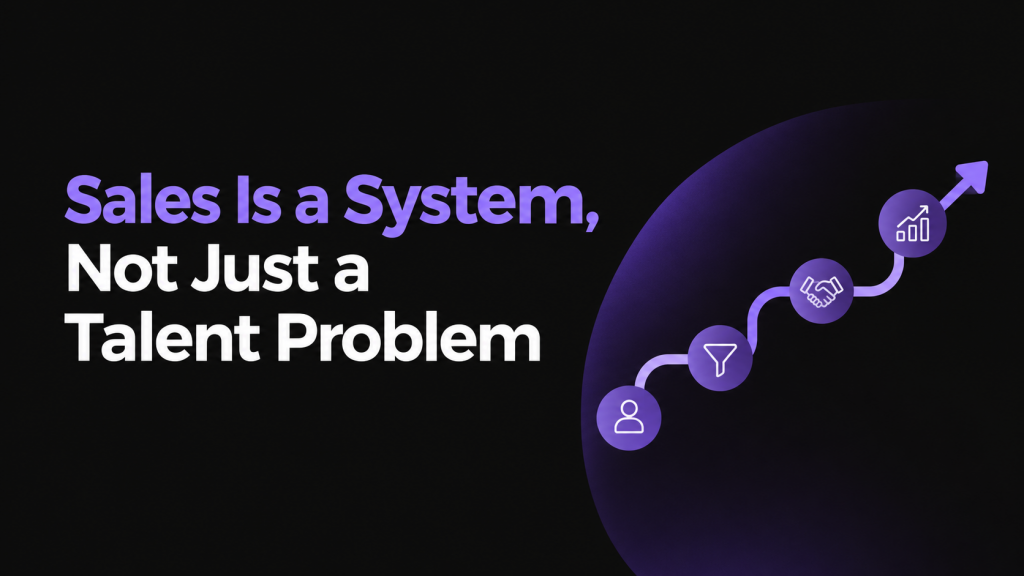
There is throughput: how much the team produces over time.
There is a bottleneck: the point where work gets stuck and slows everything downstream.
There is cycle time: how long it takes to move from a lead to revenue.
There are avoidable losses: leads not followed up, opportunities that go cold and deals lost because something in the process broke down.
And there is conversion: how much of what enters the sales process actually becomes revenue.
These are not simply questions of whether someone is a good salesperson. They are questions about how the system is working.
Why talent alone has a ceiling
Talent matters. A great salesperson can build trust, understand a customer and close a difficult deal.
But if your growth depends entirely on exceptional individuals, scaling means constantly finding more exceptional individuals.
There is another problem. If your best salesperson succeeds but nobody can explain exactly what they do differently, that knowledge stays with them.
You cannot easily teach it, reproduce it or improve it.
A visible process changes that.
You can see where things slow down, understand what is working and identify what needs to change.
The human part still matters
Looking at sales as a system does not mean taking the human element out of selling.
Trust matters. Judgement matters. Relationships matter.
The point is to stop relying on those skills to compensate for a process nobody can see.
When the system works, your best people can focus on selling. And when you understand what makes them effective, you have a better chance of helping the rest of the team do the same.
That is the thinking behind Laddar Field OS: making the sales operation visible so teams can understand what is happening, identify where work gets stuck and improve how the operation runs.
When sales feels unpredictable, the question is not always:
“Do we need better salespeople?”
Sometimes it is:
“Can we see how our sales process is actually working?”