The Layers of a Modern Sales Operation: People, Execution, Communication, Data
Ask most businesses how they manage sales and you get a list of tools. Ask how those tools connect and the conversation goes quiet. That gap is why so many sales operations feel busy but disjointed: each part is managed, but the parts do not add up.
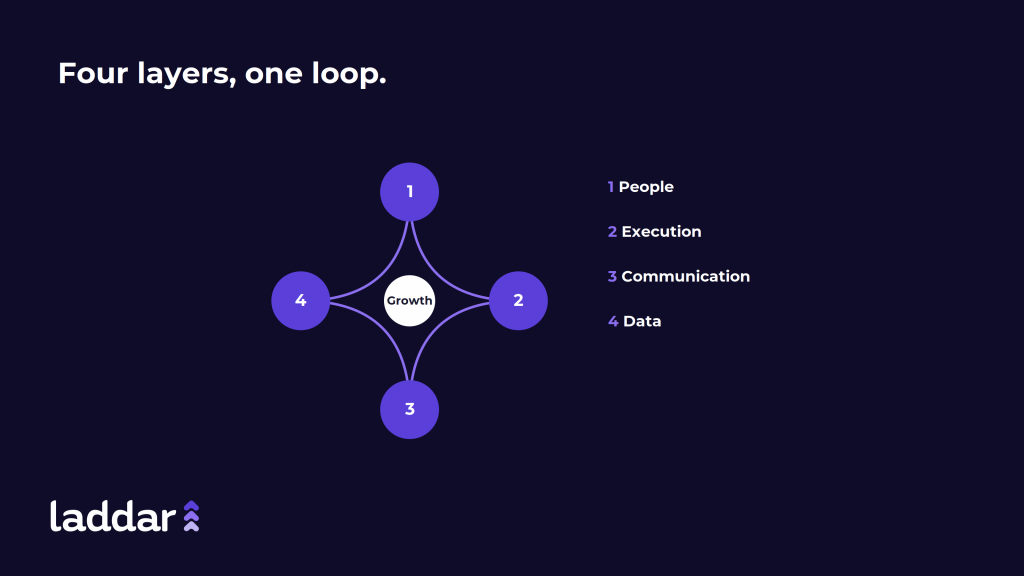
A useful way to fix that is to stop thinking in tools and start thinking in layers. A modern sales operation runs on four, and they only produce growth when they run together.
Layer one: People
Nothing sells without the right people in the field. This layer covers who you recruit, how quickly you onboard them, whether they are verified and deployed to the right territories, and how you scale the team without scaling chaos.
Most businesses treat this as a hiring problem and stop there. But people are the input to everything downstream. A weak people layer means the other three layers are managing the wrong agents, slowly. This is the layer Laddar People addresses: access to sales talent, and the means to deploy it.
Layer two: Execution
This is the operating layer, where the work actually gets run and made accountable. Campaigns launch, agents are assigned, field activity is captured and verified, sales are logged, incentives are calculated, performance is tracked.
Execution is the layer most businesses manage worst, because it is the hardest to see. It happens in the field, out of sight, and it usually lives in spreadsheets and personal phones rather than a system. This is the core job of a sales operating system, and specifically of Laddar Field OS: to make execution visible, connected and accountable.
Layer three: Communication
Selling and serving customers runs on conversations: inbound calls, outbound campaigns, follow-ups, support. When those happen on personal phones, the business cannot see them, cannot coach them, and loses them when an agent leaves.
The communication layer gives customer conversations a business identity, a record and a measurable outcome. This is what Laddar Voice provides: inbound and outbound calling, recording, monitoring and analytics, so conversations become part of the operation rather than something that vanishes into a private chat.
Layer four: Data
The fourth layer is what the other three produce and consume: the activity, the sales, the conversations, turned into something you can act on. Data is not a report you read at month end. It is the feedback that tells the next campaign who to target, which agents to coach, and where the operation is leaking.
Without a data layer, the first three run blind and cannot improve. With it, the operation learns.
The flywheel: why the layers must connect
Laid out separately, these are four functions. Connected, they become a flywheel:
People feed execution. Execution drives communication with customers. Communication and execution generate data. Data optimises the next round of people, execution and communication. And that loop, run well, produces growth.
The reason so many operations stall is that the layers are managed by separate tools that do not pass information to each other. The people system does not talk to the execution system, which does not talk to the communication system, which does not feed the data. The flywheel cannot turn because the links are broken.
A sales operating system exists to connect the layers so the flywheel turns. That is why Laddar Africa built People, execution and communication to work as one ecosystem rather than three products bolted together: People plus Laddar Field OS plus Laddar Voice, feeding one data layer.
What to do with this
You do not need to fix all four layers at once. But it is worth auditing them honestly: which layers do you actually manage, which do you improvise, and, most importantly, do any of them connect. If your answer is that each is handled by a separate tool with no link between them, your constraint is not any single layer. It is that your flywheel has no bearings.
FAQ
What are the layers of a sales operation? People, who sells; execution, how the operation is run and made accountable; communication, how customers are reached and conversations captured; and data, what all of it tells you and how it improves the next cycle.
Why do sales operations feel disjointed even with good tools? Usually because each layer is handled by a separate tool that does not pass information to the others. The parts are managed, but they do not connect, so the operation cannot see itself as a whole or improve as one.
How does connecting the layers drive growth? When people, execution, communication and data feed each other, the operation becomes a flywheel: each cycle informs the next. Disconnected, the same functions run blind and cannot compound.
See how Laddar Field OS connects the layers of your sales operation.