Why business calls should never live on personal phones
In many growing businesses, customer calls happen on personal phones. A sales rep gives a customer their own number. A support agent calls back from their SIM. It feels practical: everyone already has a phone, and it costs nothing to set up.
The hidden cost shows up later. When an agent owns the number, they own the customer.
What goes wrong with personal numbers
Customers leave with staff. When a rep resigns or moves to a competitor, customers keep calling the number they know. The relationship, and often the revenue, follows the person, not the business.
No history, no context. Calls on personal phones leave no shared record. A new team member has no idea what was promised, discussed or agreed before.
No visibility for managers. Leaders cannot see how many calls were made, missed or returned, or how customers are being treated on them.
Inconsistent customer experience. Customers see a different number every time. Some calls go to voicemail on a weekend. Others are answered in a noisy market.
Privacy and boundaries blur. Staff receive work calls at all hours on their personal lines, and their private numbers end up in customer contact lists.
What business-owned calling looks like
The fix is not to take phones away from staff. It is to separate the business line from the personal one, while keeping the convenience of a mobile phone.
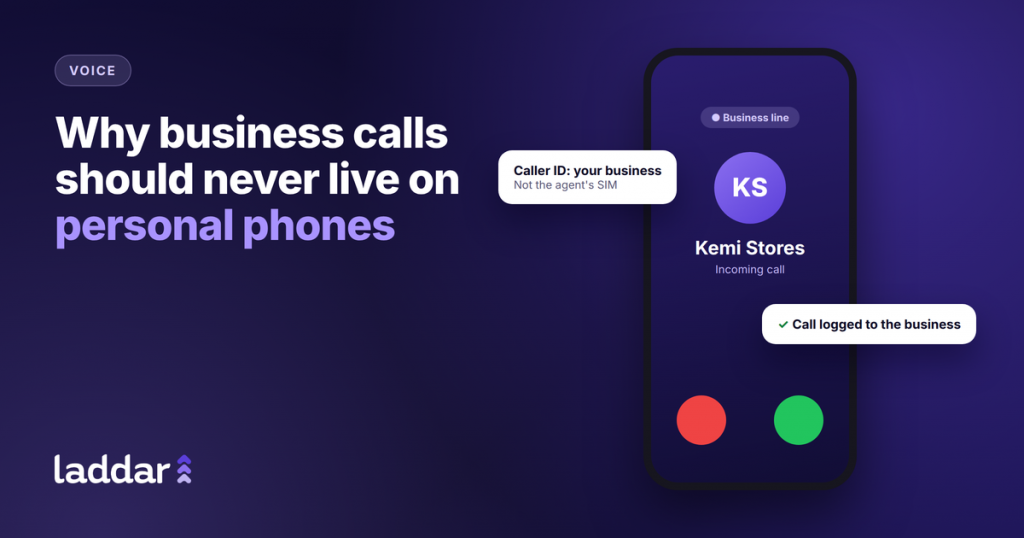
A dedicated business number on the existing phone. Staff use their current device, but business calls run on a separate business number with its own caller ID. Their personal number stays private.
Separate business call logs and voicemail. Business calls are recorded in business logs, not mixed with personal calls, so the company keeps the history.
A shared contact directory. Customer contacts belong to the business, so anyone taking over an account has the full list and context.
Recordings and oversight. Calls can be recorded and reviewed for quality, training and dispute resolution.
Easy handover. When someone leaves, their business line and its history can be reassigned. Customers keep calling the same number, and someone new picks up.
Taking business calls back, step by step
- List the roles that talk to customers. Sales, support, collections and account managers are usually the priority.
- Give each a business line. Assign dedicated business numbers, or route calls through a shared call center line where teams work together.
- Move customers over. Share the new numbers through invoices, messages and signatures so customers learn the business line.
- Set clear rules. Business calls go through business lines only. Personal numbers stay personal.
- Review regularly. Use call logs and recordings to coach the team and spot missed calls.
How Laddar Voice helps
Laddar Voice offers two ways to run business calls. Staff Lines give each person a dedicated business number on their existing phone, with business caller ID, separate call logs, voicemail and a business dialer. The Call Center Solution gives teams a central system for multi-agent calling, with call history, recording, routing, transfers and analytics.
The bottom line
Your customer relationships are business assets. Keeping calls on business-owned lines means customers, history and control stay with the company, even when people move on.
Take your business calls back.