
Span of Control: How Many Sales Agents Can One Manager Actually Handle?
Most conversations about scaling a sales team focus on the agents. The more useful question is about the manager: how many people can one of them actually see, coach and hold accountable at once?
That number, not your recruitment budget, is the real ceiling on your team. And it is usually far lower than the org chart pretends.
Three zones of management attention
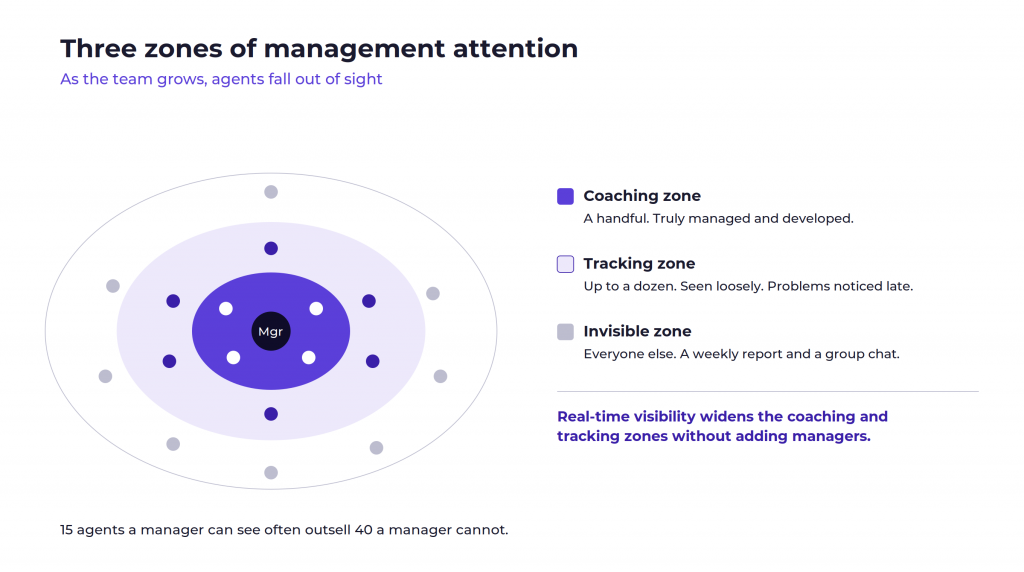
Think of a manager’s attention as falling into three zones as the team under them grows.
The coaching zone. A small group, a handful of agents, that a manager can genuinely coach. They know each person’s numbers, their strengths, where they are stuck, and they can intervene in time to change an outcome.
The tracking zone. A larger group, perhaps up to a dozen, that a manager can keep loose track of. They know roughly who is doing well and who is not, but the attention is thin. Problems get noticed late.
The invisible zone. Everyone beyond that. Here, management is no longer management. It is a weekly report and a group chat. The manager finds out what happened after it happened, when it is too late to act.
When you add agents without adding management capacity, you are not expanding the coaching zone. You are pushing more and more people into the invisible zone.
Why this caps revenue, not just comfort
This is not a soft, human-resources point. It shows up directly in revenue.
Agents in the coaching zone get corrected, encouraged and developed, so they improve. Agents in the invisible zone are left to their own discipline. The strong ones hold up. The rest drift, quietly, and nobody notices until the numbers are already down.
This is why a team of 15 under a manager who can see them often outsells a team of 40 under a manager who cannot. The larger team has more people and less management, and the missing management is where the lost sales live.
The classic answer, and why it is incomplete
Traditional management theory offers rough spans of control, often somewhere in the range of a handful to a dozen direct reports, depending on complexity. For a field sales team, complexity is high: people are distributed, mobile, working in different markets, often out of sight.
So the manual, unaided span for a distributed field team sits at the low end. One manager, managing by phone calls and end-of-day reports, can truly hold only a small number of agents in the coaching zone.
But that number is not a law of nature. It assumes the manager is doing all the seeing themselves, by hand.
How to raise the span without adding managers
There are two ways to manage more agents well. You can add another layer of managers, which adds cost and distance. Or you can extend how far each manager can see.
When a manager can see, in real time, who is active and where, which visits actually happened, and how each agent is tracking against target, the tracking zone expands dramatically. Work that used to require a phone call and a wait now sits on a screen. Problems that used to surface a week late surface the same day, while there is still time to act.
That does not make coaching automatic, but it removes the blindness that forced the span to stay small. A manager who can see 40 agents clearly is closer to the coaching zone with all of them than a manager flying blind is with 15.
This is one of the clearest jobs Laddar Field OS does. It gives sales managers real-time visibility of a distributed team, which is often a cheaper and faster way to gain capacity than hiring another layer of management.
The practical takeaway
Before you next redesign your team structure, do not start with how many agents you can afford. Start with how many your managers can actually see today.
If the honest answer is “far fewer than they are responsible for,” you have found your real constraint. And it is one you can often fix without hiring a single extra person, agent or manager, by making the team you already have visible.
FAQ
What is a realistic span of control for a sales manager? It depends on complexity and on how much of the seeing is done by systems rather than by hand. For a distributed field team managed manually, the number a manager can truly coach is small. Real-time visibility tools raise it considerably, which is often cheaper than adding another management layer.
Is it better to add more sales managers or better management tools? Adding managers adds cost and distance between leadership and the field. Extending each manager’s visibility raises capacity without either. For most distributed teams, improving what one manager can see is the faster and cheaper lever.